

A Room For Remembering
making space for grief in the home

Love Notes to Grievers was first an Instagram page, which evolved into a self-published book, was picked up by an all-women-led Canadian small publishing house, and was expanded into a new version of the book (currently on super sale in the US sorry about the amazon part* grab a bunch for those in your life that need grief support) It has now become this newsletter, which I have neglected since I left my other social media platforms back in October.
Thanks for your patience as I reconnect with you all here. If you would do me a favour and share it with your people on socials and grab a copy of my book from your local bookstore. You would be doing this writer a solid. <3
I’ve never been a witchy gal, but I have some humans in my life who cast a few spells. I’ve also tried to understand my astrology, but I forget the details when someone explains it to me. Tarot? I’ve got a deck or two— collecting dust.
Aquarius moon, Aquarius sun, something about Capricorn in there. Placements—forget it. Some plan their yearly calendar around their birth chart. While I try to remember to eat breakfast.
A ritual/cultural anchor for me, one that I can make sense of and tend to most days, is my ancestral altar. Where framed pictures of my dead loved ones are displayed on top of a dark wood-stained, low to the ground table. My father’s photo is at the center, and both sets of grandparents and some of my great-grandparents are placed above him on a shelf, and my other loved ones who have passed are there too.
There’s a rosary I bought at the Carthusian Monastery in Serra San Bruno, Italy, where my grandfather Ralph’s parents are from. He was born in Connecticut shortly after they immigrated to the United States, before they made the trek to Northern Ontario, Canada, to settle. It hangs on the left side of a framed picture of my grandmother, Violet. I got the rosary on the trip my mom, brother, and I took back in 2023. My dad had been dead for four years at that point, and my grandmother for three.
Sometimes I have fresh flowers in a vase, and scattered throughout are different candles—tea lights, tapered beeswax and a few devotional candles. The practice of providing fiammelle (tiny lights) is a way to welcome the spirits and to show them they are not forgotten. It’s the bridge between two worlds, the one we are part of here and the spiritual one.
There is also my grandfather, Ralph’s (Raffaele), ring and his watch. Common to have items of deceased loved ones be part of the altar space. I finally got a frame at the thrift store for the picture of him and my gran on their anniversary that my mom gave me when I was visiting back in February.
There’s a change purse of my great-aunt Julie’s on my dad’s side, who I was close with and cared for her alongside my family when she got dementia in her later years. My mom and I had the honour of sitting vigil and holding her hand as she took her final breaths.
There are pictures scattered on the table—a place to remember, not stuffed in a box only to be pulled out every few years or at all.
They were here. They matter. They are still here in memory and part of me and my daily life.
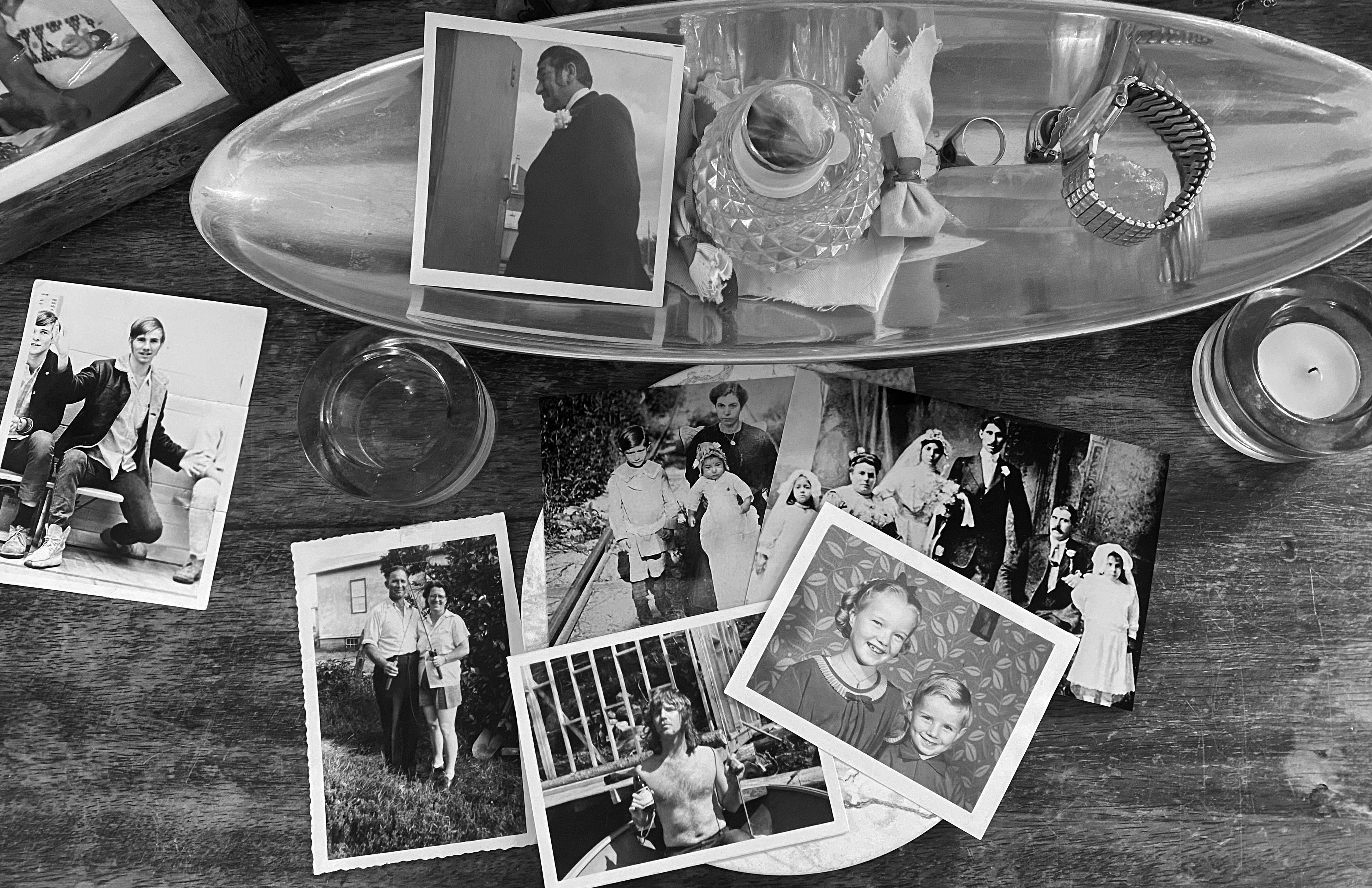
The cool dude on the bottom center, shirtless with a mullet, is my pops looking rad as hell, per usual.
If you are following my writing here, chances are that you are grieving. I think a great starting point can be an individual altar for your loved one, if an ancestral one feels overwhelming and because some of you have fractured lines of descent and painful familial relations, and I so honour that.
I tend to this altar almost daily or at the very least say hi as I walk into the room. Talking to the dead can feel a bit silly at first if you aren’t used to it. Yet, I have come to love building connections with the people I didn’t get to meet. Picturing their life in Italy, the food they ate, the struggles they had and the early days heading to North America, the nerves they must have felt going to a foreign place where you don’t speak the language, boarding a massive ship to take you there, and eventually settling in Canada. And the ones I did have a deep connection to, that’s a little harder to hold at times.
Having an altar in the home for the dead is common across many cultures. It is part of my Italian heritage on my mother’s side. I grew up with pictures of our dead loved ones in my parents’ room and throughout the house. My mom has a small altar for my dad in the house she moved into shortly after he died. As is having statues of the family’s patron saints: Saint Joseph, Saint Anthony of Padua, St Francis, the one my gran constantly talked about, the patron saint of lost things, St. Anthony (probably because I was always losing things).
“Pray to St. Anthony, and he will help you find it,” she’d say
Having an altar space is a way to pay respect to our deceased family members. To be with the grief and the love. I’m still figuring out the specific traditions of the region my family comes from, Campania and Calabria. I take great pride in the ways I try to implement them into my life.
As you have gathered, I am not all in on one thing. I’m not religious, but many in my family were, so I try to reflect that in the altar space as a sign of respect.
Below are a few tips for setting up your altar. Keep in mind, I am not an expert on this, but it’s become an important aspect of my life. This is to get you started. Feel free to reach out or share your experience if this is new to you.
Placement:
Mary-Grace, the author of Italian Folk Magic, recommends picking a central place for your ancestral altar, one that has a lot of activity. Family room, entranceway. Pick a place that they can be part of your daily life, or one that feels good to you. Other cultures may suggest a quiet and peaceful place. Creating an altar of this kind is deeply personal, and I am writing vaguely about it for a reason.
Surface:
Depends on where you live and what kind of altar you would like to have. Some people have a photo wall, and arrangements can be done in many ways. Some like to put the oldest ancestors at the top and the more recent passings at the bottom.
The way I prefer is to have ancestor photos and personal items on a dedicated shelf or altar table. Placing a runner or altar cloth is common.
You can also have objects or pictures of the area or region your ancestors are from. I could print off some of the pictures I took while in Naples and Serra San Bruno. If you don’t know where your people are from, it’s a great time to call someone in the family to ask or do some research yourself.
I may split up my altars at some point to have one just for my dad, but for now, everyone is all together.
For some, finding and reclaiming your cultural background, how they lived, what they ate, how they mourned, creating altars, honouring the dead, is a beautiful way of being with the grief you’re carrying. This won’t be for everyone, but it may be for some.
It’s great to be back in connection with you here,
Ange
I love this down-to-earth break down of your altar. It feels like such a great reminder/permission that this can be literally anything we want it to be. Last year I was working with cyanotype (sun prints) & felt such a huge urge to do prints of my dead grandma for my own altar. It now feels extra special talking to her on a paper I made myself. Another way to connect with her in the after life ✨
PS: I just bought your book and can’t wait to read!